what is it like to not have children
Update September 2019: Wow. It'south been two years since I published this postal service and the comments are still pouring in.
Reading these comments volition teach you more than about human nature than the article volition because of the strength of man biases (especially cognitive dissonance reduction and confirmation bias) that is being portrayed.
Please read the commodity before leaving a comment. Cheers
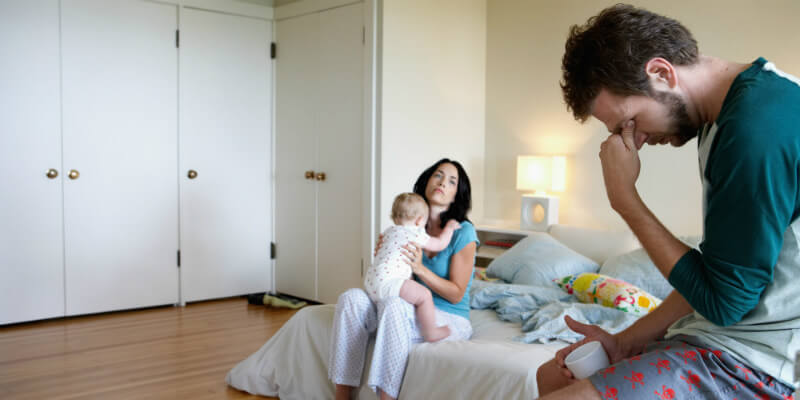
Exercise yous recall having children makes yous happier?
If and then, think again.
Research shows (over and over over again) that having children reduces happiness (due east.thousand. Anderson, Russel, & Schumm, 1983 or Campbell, 1981), fifty-fifty though parents call back it volition make them happier.
This phenomenon is known equally "The Parenthood Paradox" or "Parenthood Gap".
Earlier you continue, we idea you might like to download our three Positive Psychology Exercises for free. These scientific discipline-based exercises will explore cardinal aspects of positive psychology including strengths, values, and self-compassion, and will requite you lot the tools to enhance the wellbeing of your clients, students, or employees.
Why don't children make parents happier?
One of the ascendant explanations for this is that children increment the amount and level of a variety of stressors that parents are exposed to (Drinking glass, J., Simon R.W., Andersson Thousand.A., 2016,), such as:
- time demands
- energy demands
- sleep deprivation (potentially starting a vicious circle)
- work-life balance disturbances
- financial brunt
It goes without saying that all of these stressors utilise even more to the lives of unmarried parents. This is why unmarried parents report the everyman levels of well-existence compared to married or single couples who are living together.
To make matters worse, people mostly go less satisfied with their union when they have children (making the attempt to fix a marriage by having children even more ironic).
Inquiry shows the disadvantages of parenthood to be the strongest in the United states of america. Nosotros'll talk more than about this in a bit.
When parents are at their happiest
In his seminal piece of work "Meanings of Life", Roy Baumeister tells united states of america that there are two happiness peaks in the lives of adults in America, namely:
- between the wedding and the birth of the first child
- betwixt the departure of the last child from dwelling house and the death of one'due south spouse
And then if you're looking at children from the perspective of personal happiness, the phases of the married life without children are the happiest periods. Yet another argument against having children for the sake of personal happiness (what's the score, 3 to 0 for not having children now?).
The good news
I can hear you thinking… but there's got to be an explanation for why we're making children, correct? Otherwise, nosotros would never have gotten this far equally a species!?
Correct.
And in that location is.
Because equally emotionally taxing equally having children may be, it has as well proven to exist a great source – if not the almost powerful source – of life satisfaction, self-esteem and significant, especially for women (Hansen, T., Slagsvold, B., Moum, T., 2009), even though men are a lot more likely to view childlessness as disadvantageous (Blake, J., 1979,).
This is true even, or even more then, during tough times and is illustrative of the fact that cognitive evaluation (what you recall) and emotions (what you experience) are not on the same continuum.
I.east. we tin value something and observe it meaningful even if it detracts from our happiness in the moment.
In the words of Baumeister:
"Sometimes the quest for meaning can override the quest for happiness."
Only wait a minute.
That sounds familiar…
Would you plug in?
Practise you recall Robert Nozick'due south thought experiment of the Feel Motorcar?
He asked people to imagine a motorcar that would provide them with only pleasant experiences as soon as their brain was hooked onto it. Let's say it's a machine triggering dopaminergic and endorphinergic action in the brain without building habituation or tolerance and without side-furnishings.
Would you choose to be hooked onto that machine?
Most people said "no" even though, rationally speaking, it would make sense to do and then. That is, if your goal is to maximise happiness for yourself, which is the case for hedonists and certain types of utilitarians.
Like i of my favorite writers Tim Urban (n.d.) remarks:
"In the end, I think I probably would skip the machine. And that's probably a dumb choice."
This brings united states of america back to the Parenthood Paradox.
A possible explanation for why the negative touch on of having children on personal happiness is the highest in the United States might exist its extreme focus on personal happiness (and hedonistic values).
There I said it.
The Parenthood Gap exists considering of unrealistic expectations and desires regarding personal happiness.
And inquiry is indeed pointing in the direction that the more individualistic a social club is, the greater the Parenthood Paradox is (the level of fiscal back up from the government beingness another of import gene).
All this leads us to the real paradox…
The real paradox is not the Parenthood Paradox, just why people seemingly strive for personal happiness fifty-fifty though they would cull meaning and/or life satisfaction (subjective evaluation of one'due south life as a whole) over personal happiness when push button comes to shove.
It goes to evidence that, once again, we not only suck at predicting what volition make u.s.a. happy (as explained in Dan Gilbert's "Stumbling on Happiness"), just also at valuing our personal happiness compared to other things, such as meaning in life.
And besides… happiness is so fragile.
Happiness fades with the commencement punch that life throws at you.
The solution
The solution is to avert falling casualty to the illusion that happiness results from meeting your ideal version of life.
Rather than belongings on to an image of what a happy life should look like and comparison it to your current life, you can permit life to unfold with unexpected moments of happiness.
Having children will not make you happier, nor does not having children.
It is not what life offers, simply what nosotros believe that life should offer that prevents us from experiencing happiness.
So let go of your expectations and lower the importance of your personal happiness. Thereby y'all will lower the stress you experience from non being every bit happy every bit you call up you should exist.
In his book "If Yous Are So Smart, Why Aren't Y'all Happy", my friend Raj Raghunathan remarks:
"Considering when one pursues happiness, one is probable to compare how one feels with how one would ideally like to feel, and since we more often than not want to feel happier than nosotros currently do, nosotros are likely to feel unhappy about being unhappy if we pursue happiness!"
This, Raj. This.
And non only do nosotros feel unhappy about being unhappy, we tin can start to experience even more unhappy because we don't know why we aren't happy, specially if we have all the reasons to be happy.
Merely that's a song for another fourth dimension.
Delight enjoy your parental unhappiness, for y'all accept all the reasons to.
Best,
Seph
We hope you enjoyed reading this article. Don't forget to download our iii Positive Psychology Exercises for free.
- Anderson, Due south. A., Russel, C. Due south., & Schumm, Westward. R. (1983). Perceived marital quality and family life-wheel categories: A further analysis.Journal of Marriage and the Family, 45, 127-139.
- Baumeister, R. (1991).Meanings of life. New York, NY: Guilford Press.
- Blake, J. (1979). Is zilch preferred? American attitudes toward childlessness in the 1970s.Periodical of Spousal relationship and Family,41(two), 245-257.
- Gilbert, D. (2006).Stumbling on happiness. New York, NY: Vintage.
- Glass, J., Simon, R. W., & Andersson, Grand. A. (2016). Parenthood and happiness: Furnishings of work-family reconciliation policies in 22 OECD countries. American Periodical of Sociology, 122(three), 886-929.
- Hansen, T., Slagsvold, B., & Moum, T. (2009). Childlessness and psychological well-being in midlife and old historic period: An examination of parental status furnishings across a range of outcomes. Social Indicators Enquiry, 94(2), 343-362.
- Nozick, R. (1974). Anarchy, state, and utopia. New York, NY: Basic Books.
- Raghunathan, R. (2016). If you lot're so smart why aren't you happy: How to plow career success into life success. London, Great britain: Vermilion.
- Urban, T. (n.d.). The experience automobile idea experiment. Retrieved from https://waitbutwhy.com/table/the-experience-machine
Source: https://positivepsychology.com/parenthood-paradox/
0 Response to "what is it like to not have children"
Postar um comentário